
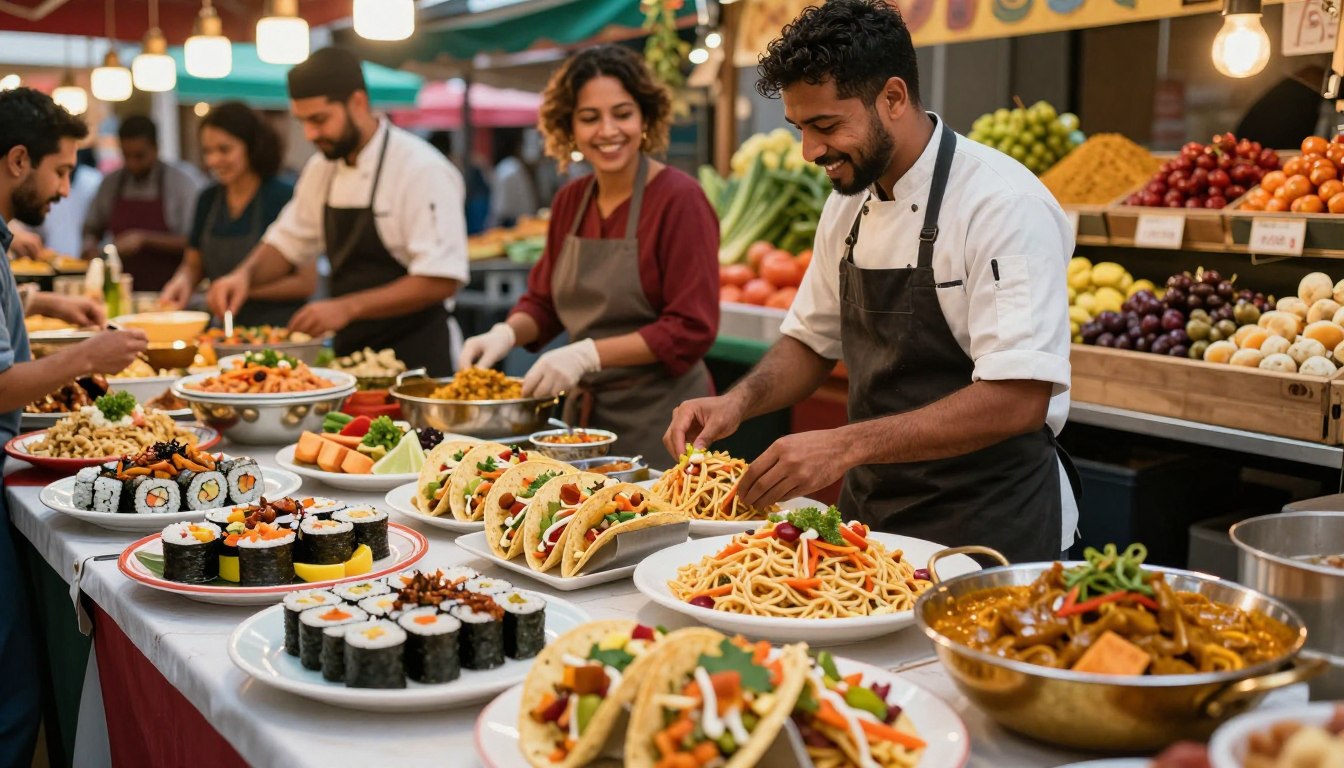
Every culture tells its story through food. What people grow, how they cook, who sits at the table and what is served on feast days reveal more about a society than many history books. This guide looks at food culture around the world: what it is, how it is protected, how it is changing and how travellers can experience it with curiosity and respect.
Food culture at a glance
- Definition: food culture is the set of practices, beliefs and rituals around producing, preparing, sharing and eating food.
- Protected heritage: UNESCO lists food traditions such as the French gastronomic meal, Japanese washoku, Korean kimjang and the art of the Neapolitan pizzaiuolo.
- Main threat: the loss of local knowledge as diets become more global and more processed.
- For travellers: markets, home cooking, street food and local festivals are the most direct ways in.
What is food culture?
Food culture covers everything that surrounds a dish: the climate and soil that decide what grows, the techniques passed down in families, religious rules and festivals, the timing and order of meals, and the etiquette of the table. Two countries can share the same ingredients and still have completely different food cultures, because the meaning of a meal lies as much in the ritual as in the recipe.
Food traditions recognised as world heritage
Since 2010, UNESCO has added several food traditions to its list of the Intangible Cultural Heritage of Humanity. They are a good map of how diverse food culture can be:
- The gastronomic meal of the French: the ritual of a festive meal, from choosing dishes and wines to the order of courses.
- Traditional Mexican cuisine: a farming and cooking system built around maize, beans and chilli.
- The Mediterranean diet: shared by Italy, Spain, Greece, Morocco, Cyprus, Croatia and Portugal; see our guide to Mediterranean food culture.
- Washoku: the traditional dietary culture of the Japanese, especially for New Year.
- Kimjang: the collective making and sharing of kimchi in Korea before winter.
- The art of the Neapolitan pizzaiuolo and hawker culture in Singapore, proof that street food can be heritage too.
Why culinary heritage is at risk
Globalisation has made more foods available to more people than ever, but it has also flattened diets. Local varieties of grain, fruit and livestock disappear when farmers switch to a few high-yield crops, and family recipes vanish when no one has time to learn them. Movements such as Slow Food, founded in Italy by Carlo Petrini in the 1980s, respond by cataloguing endangered foods in its Ark of Taste and supporting the small producers who keep them alive. We tell this story in our Italian article on Carlo Petrini and food as an act of longevity.
Protected designations help too. In the European Union, labels such as PDO and PGI tie products like Parmigiano Reggiano or Feta to their region and traditional method of production.
How food culture is changing
- Back to fermentation: kimchi, kefir, miso and sourdough have moved from grandmothers’ kitchens to restaurant menus.
- More plants, less meat: many cuisines are rediscovering their traditional plant-based dishes rather than inventing new ones.
- Fusion with roots: second-generation cooks in cities like London, Paris and Berlin mix their family traditions with local produce.
- Less waste: nose-to-tail and root-to-stem cooking echo the thrift of every peasant cuisine.
How to experience food culture when you travel
- Start at the market: it shows what is in season and what locals actually buy. Our list of the best food markets in Europe is a good place to begin.
- Eat at local hours and order what the people at the next table are having.
- Take a cooking class with a home cook rather than a hotel chef.
- Go to a food festival: in Italy, village sagre celebrate a single dish or ingredient, like the Sagra de Sa Panada in Assemini, Sardinia.
- Learn the etiquette: what is polite in one country can be rude in another.
Food culture: FAQ
What is the difference between cuisine and food culture?
Cuisine is the set of dishes and techniques of a place. Food culture is broader: it includes how food is produced, shared and given meaning, from farming and markets to festivals and table manners.
Which food traditions are protected by UNESCO?
Examples include the French gastronomic meal, traditional Mexican cuisine, the Mediterranean diet, Japanese washoku, Korean kimjang, the art of the Neapolitan pizzaiuolo and hawker culture in Singapore.
How can I help preserve culinary heritage?
Buy from small producers and local markets, choose seasonal and regional products, and learn traditional recipes from older relatives before they are lost.

Manuale Creativo per Fotografi Ribelli
40 idee per riscattare il tuo sguardo fotografico. Un libro di Massimo Usai per chi vuole guardare il mondo con occhi nuovi.
Acquista su Amazon In qualità di Affiliato Amazon ricevo un guadagno dagli acquisti idonei.Scopri di più da Urban Mood Magazine
Abbonati per ricevere gli ultimi articoli inviati alla tua e-mail.


