
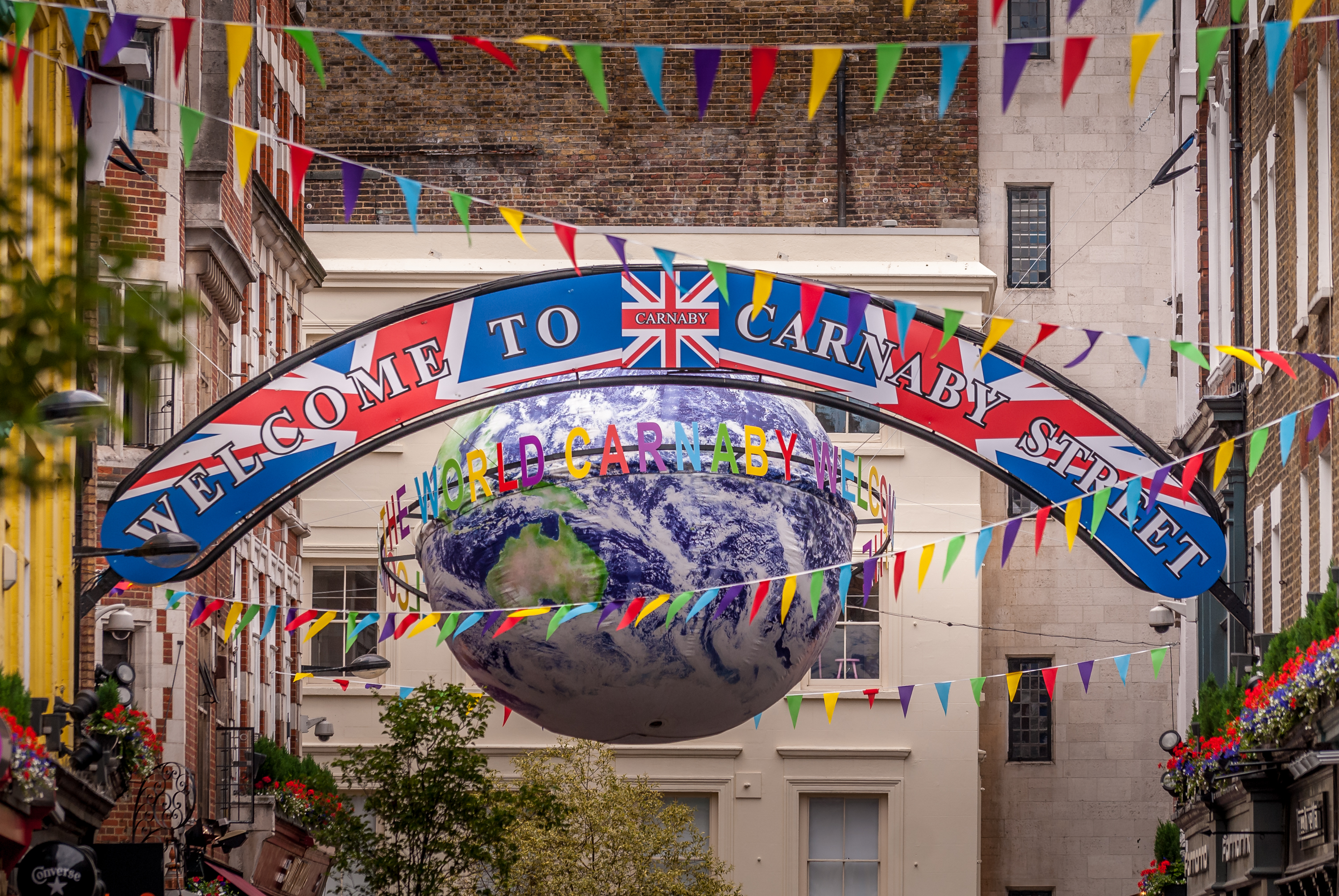
Photo above: Carnaby Street welcomes the world to London in 2012 (photo by @massimousai)
By Massimo Usai · Written in May 2021, updated October 2026 · Leggi la versione italiana
A note before you read (October 2026). I wrote this essay in May 2021, as the hardest phase of the pandemic was ending in the UK. Ten years after Brexit, and the referendum that set it in motion, I am republishing it almost exactly as it was: a snapshot of how it felt to be a European in Britain at that moment. I have only corrected typos and clarified a few references that time had made unclear. What has changed since 2021 is at the end of the article.

1. The starting point
Where does all this disappointment and pain that I have to endure these days come from?
From the long closure of the last 16 months because of the pandemic?
From the fact that my Arsenal are having their worst season in decades?
Maybe I noticed my summer shirts are definitely tight, and I need to act fast?
I don’t think that they’re the cause. I need to start exactly from a specific year, a leap year: 2012.
In 2012 I thought I was experiencing the beginning of a more than exciting phase for my life and for the country I was in, Britain.
Our spirit in general was skyrocketing.
I don’t just mean mine: we were all happy and friendly with each other.
With everyone! From the neighbour to one of the many tourists (do you remember when we still had “tourists” around?) who filled the city at the time.
Families invited tourists into their homes, using their empty rooms to help host so many visitors while earning some extra income.
2. 2012: the Olympic Games
The weather was great. We seemed to be living an endless spring, which began on the night of December 31st.
The fireworks that greeted the New Year had been spectacular and exciting, and brought down a few tears of emotion.
In March, the flowers seemed never to have been so happy to show the thousand colours they knew how to create.
Maybe in other years we had been so distracted, angry and worried that we never noticed those colours had always been there. But that year they seemed unique.
In 2012, everything was different and unique.
It felt like we had put all the worries of our lives aside. We were hugging people, smiling on the Underground at anyone who crossed our eyes.
Everyone was cheerful, radiant and confident.
What a time to be alive!
The Queen had begun the celebrations for the 60th anniversary of her reign as early as February.
Flags were in every corner of the city, and flags from every nation in the world were flying from the windows of people’s houses.
It was not only the British who celebrated: anyone who lived in the country felt part of what was happening.
In a way, those of us who came from abroad felt it even more than many English citizens living distracted lives in some small town in the north of the country.
And I, like everybody else, simply had the greatest party of our lives.
Businesses were breaking their sales records; everything was going well.
The oil for these gears was called “motivation” and “joy of life”, and the glue was a magic word: “share”.
A glue you don’t buy at the supermarket, but that forms within people.
On July 27th, the Olympic Games opened in the new stadium built in East London.
The world, and not just Britain, seemed to be heading towards a cycle of happiness, hope and joyful life.
We all felt that the work of the last 15 years, everything anyone had done in life, had reached its goal.
A thousand dreams, projects and hopes came true that evening at the end of July.
No one had any doubts: from tomorrow, everything would be perfect.
For about a year it was like this around London. A long Olympic wave, and the mild, almost Mediterranean weather of 2012 seemed to drag on into the following year.
If you looked into the gardens that every house in London has, you saw olive and lemon trees thriving. The climate felt more like the South of France than the stereotypical English town.
But something, on the other hand, was changing, and we didn’t immediately notice.
There was no longer a rise in cultural and economic growth ahead of us: we were on a plateau, where everything was flat.
We still looked at the rest of the world from above, but we didn’t realise we were standing on a false plain.
We were stunned, still drunk on happiness and optimism, and didn’t notice a lot of what was happening.
The signals were all around us, but we couldn’t spot them.
Maybe it was just me who couldn’t see it, but I knew I wasn’t alone in this blind spot.
Probably the honest analysis is that “we didn’t want to spot them”, because we couldn’t believe what was happening was true. Inside us, we could not accept that something was spoiling the party.
2012 was not the first year of a decade, or more, better than the previous 20 years. It was the summit of that climb and the end of a golden period.
What happened after that is still recent history, which we are living now, at this exact moment.
Brexit and its historic rupture split people, families and friendships, and opened inexplicable divisions between different cultures.
If history serves as a warning and a measure for reading current events, then we are facing the rise of a new form of fascism, run by cowardly, greedy and vindictive people.
People whose humanitarian sense barely exists, because money and power are the only reasons they live.

3. Brexit: the night of 23 June 2016
On the night of June 23rd, 2016, I didn’t sleep.
Since that night, I slept badly for years.
I didn’t feel comfortable where I was anymore.
Four years earlier I had noticed something about many people in the north of the country: they had no interest in the Olympics. They did not see them as “their Olympics”; they called them the “London Olympics”.
Many people in the North felt resentment and jealousy towards the South.
It is a historical grievance towards the centre of economic power.
So we, living in London in particular, became the target.
What we believed we were creating in the capital, something extraordinary and cheerful, was not appreciated by people who didn’t feel what we were feeling.
Like an army with nothing to lose, they decided to break the game.
Even if it damaged themselves. That self-harm did not matter, because they felt the game was not in their hands. “We are not at the centre of this country’s life” was the sentence you heard most often in interviews.
I had seen this hostility towards the South every time I followed Arsenal away in the north. It was so fierce that I felt more “abroad” there than when I actually left Britain.
The quality of life and social relationships in Bolton, Blackpool or Wigan were very different from those in Balham, Putney or Fulham.
Two worlds so different that they could not meet, if those who ran the government did not want them to.
In fact, they saw the opportunity to control the masses easily, keep their personal power and maximise private profit.
“Brexit” was the idea and the key to taking control.

4. The last five years (2016–2021)
The problem was that I couldn’t fight all this on my own, so I fell into depression.
My certainties about this country and the people living there turned into a disappointment I couldn’t measure myself against.
Because the problem was not simple: it was as if I had met Tyson, and he had decided to train using my body to get back into shape.
The reality was that I did not have the tools for this personal challenge.
I felt lost, I have been for years, and it’s fair to say I still am.
The disappointment and pain still accompany me, and I know I am not the only one in this situation.
My relationships with family and friends have changed.
I have changed the way I behave with some of them; some friendships have been lost completely since those days.
Friendships I thought were important melted like ice in August in the south of Italy when you leave the fridge open.
Then came the pandemic, and a government that managed it with a closed mentality, in the same way it had run the Brexit campaign in the media.
With just one aim: to make the citizens of the UK live in a kind of bubble.
A bubble full of vanity and presumption, which opened a crack I don’t know if I will ever climb out of without further damage to my soul.
From a free, open and progressive country, Britain has become a country full of narrow-minded citizens.
People who believe the British Empire is something to be proud of, and who treat hooligan behaviour as noble. It reveals how an entire generation has been kept in ignorance, and has lost the plot.
Now this ignorance shows its true face publicly, every day and at every level.
Listening to the radio, watching the news or reading Twitter, it became very difficult not to get upset.
Reading the news about reception centres for people turned away at the borders brings down a tear, born of the pain I have carried since June 23rd.
I still feel disappointed, defeated and angry.
Yes, angry, furious with a country and a population where I spent 21 years of my life.
A country I helped to grow and improve with my passion, my work, my money and my culture.
I was so proud to be part of the country that showed its pride to the whole world in 2012.
Now it has made me someone who rejects the idea of this country. Will I ever recover from this feeling?
Because I feel betrayed, and seeing so many people adjusting to the “Nuovo Potere” (the “new power“) keeps me awake at night once again. I’ll be honest: my state of mind is close to the darkest depression I have ever experienced.
I think this is the worst time I can remember in all the decades I have followed politics in Europe. It hurts the most because it comes from a country I had always considered the most democratic, visionary and open-minded in the world.
An example to follow, and a place you had to be part of if you carried these values inside you. The country where, at the end of the last century, I decided to build my life and raise my daughter.
Thanks to YouTube, I can point you to this video, which is a reminder of who they are.
The video reminds us that it is always worth fighting these forces. In this case they are represented by Priti Patel, then Home Secretary, a minister who sends a chill down your spine every time she opens her mouth.
She is an MP for a party whose only ideal seems to be destroying everything that has positive value in our society.
A party that does not care about risking peace, and that separates and isolates the people of its own country as its first move.
Her speech reminds me of former smokers who become the most aggressive anti-smokers.
She is the daughter of immigrants herself. “A cliché“, you could say, and perhaps you are right, but a cliché that hurts.
That video is full of populist slogans; it is one of the most horrible things I have seen in recent years.
A video with so much hate, resentment and vitriol that it is the last thing you would expect from a Home Secretary. But this is where we are at the moment.
Then you try to escape this toxic atmosphere and go online.
You open Twitter or Facebook to put your mind somewhere else.
Unfortunately, you end up reading the same nonsense from so many other people, and you feel the same pain at a football match, or on the bus, where you decide to keep your headphones on at volume zero.
And it’s the lies, the slogans such as “take back control”, that make you sick to your stomach.
“Take back control”, the phrase of these years, is an incredible contradiction.
At the same time, there was “zero control” over the deadly virus that entered the country because of the presumption and incompetence they showed.
In any other country in the world, a failure like this would have brought down the whole government. But not in this Britain, not right now.
By spring 2021, the virus had killed more than 150,000 people in the UK.
And yet the population seems so happy with this ruling class that every poll shows their support rising.

5. Hopes for the future
I hope this phase does not last long, and that there is a Revolution.
Yes, you read that right: a Revolution.
And as soon as possible, because the more time passes, the gloomier and more dangerous this crisis of democracy and identity becomes for the new generations. Its cultural drift may bring negative surprises that are hard to name today.
The revolution must not be armed: in 2021 it can, and must, be different.
But it must be a change as fast as the effect of a revolution.
Not only must the government, and those who “manage” the men now in government, change. The mentality and actions of the leaders of the current opposition must change too, and so must the conscience of voters, who cannot go and vote without interest, but must be motivated.
It has to happen very quickly. It is already too late, because I want to reach the last part of my life without carrying this kind of disappointment.
I do not want to keep this memory of a country that made me cry with joy and hope, gave me so many reasons to believe, and then made the same tears fall for different reasons in the last five years.
To feel the pain of watching this anti-democratic, anything but progressive metamorphosis of a country and a people who marked my life so positively, at least until 2016.
Between depression and disappointment, I leave this long letter to the reader’s judgement, because after years of suffering in silence, I had to put my feelings into words.
With the end of the harshest phase of the pandemic, this was the right time to speak about myself, my sorrows, my disappointments and my hopes, murdered forever.
Ten years after Brexit: what has changed since 2021
When I wrote this essay, the government I described was still riding high in the polls. Five years later, the picture is very different:
- The government changed. Boris Johnson resigned in 2022, followed by the short premierships of Liz Truss and Rishi Sunak. In July 2024 Labour won the general election under Keir Starmer, ending fourteen years of Conservative government.
- A leader from the North. In July 2026 Starmer stepped down and Andy Burnham, for years the Mayor of Greater Manchester, became Prime Minister. The North I wrote about with so much anger is now at the centre of the country’s political life.
- Priti Patel is no longer Home Secretary. She left the Home Office in September 2022.
- Brexit is ten years old. The referendum turned ten in June 2026. The UK formally left the EU on 31 January 2020, and the debate about what it has cost has never really ended.
- And Arsenal? The team that was having its worst season in decades in 2021 won the Premier League in 2025/26.
Read also: Brexit, 10 anni dopo: anatomia di una frattura and Brexit e Londra: cosa resta della città europea che abbiamo amato (in Italian).
Final notes (2021)
I wrote this story in about a month.
I corrected it a thousand times and tried to limit the intense emotions I have been living with in recent years.
I wrote it because I needed to put my life in black and white on the blog, because of Brexit, and to have a point from which to start my life again.
Thank you if you have reached the end of the story, and an even bigger thank you if you help me share it.
Maybe it will help someone else who is going through a similar experience.
Massimo Usai

Manuale Creativo per Fotografi Ribelli
40 idee per riscattare il tuo sguardo fotografico. Un libro di Massimo Usai per chi vuole guardare il mondo con occhi nuovi.
Acquista su Amazon In qualità di Affiliato Amazon ricevo un guadagno dagli acquisti idonei.Scopri di più da Urban Mood Magazine
Abbonati per ricevere gli ultimi articoli inviati alla tua e-mail.


4 comments
[…] By Massimo Usai […]
[…] For all those before us and for all those after us […]
[…] Londra 2012 ad oggi, sembra che questo Paese sia stato trasformato fino al punto che è quasi […]
[…] London 2012 to now, it looks like this Country has been changed till the point is almost […]