
By Roberto Pili
Oncology, Aging Medicine, Geragogy
President, World Community of Longevity – Med Age Alliance
The Mediterranean Diet is not a fixed monument to the past. It is, rather, a living model: a cultural, nutritional and biological platform able to evolve over time without losing its identity. It is from precisely this vantage point that we should read the growing scientific interest in Moringa oleifera, a plant of notable nutritional and phytochemical properties, now studied as a possible functional addition to the prevention models tied to longevity.
The question is not whether to graft an exotic food onto a settled tradition for the sake of fashion. The point runs deeper. Contemporary medicine, and the science of healthy ageing in particular, is searching for strategies that can support the body across the whole arc of life: from early prevention in the young to the protection of organ function in the old.
Seen this way, Moringa oleifera can become a point of genuine interest for a modern Mediterranean Diet — one that holds together roots, biodiversity, sustainability and new scientific evidence.
A response to hidden hunger
One of the great contradictions of contemporary society is what we might call selective malnutrition. Many people take in too many calories and not enough essential micronutrients. We eat a great deal, often too much, without truly nourishing the body.
The result is a silent imbalance: caloric excess alongside a deficit of minerals, vitamins, fibre and bioactive compounds. This metabolic terrain can favour oxidative stress, disturbances in cellular homeostasis, chronic low-grade inflammation and a gradual loss of functional efficiency.
Moringa leaves are studied precisely for their nutritional density. They contain plant proteins, essential amino acids, calcium, iron, magnesium, potassium, zinc and vitamins. That composition makes them interesting not as a replacement for the Mediterranean Diet, but as a possible complement within a balanced, individualised way of eating.
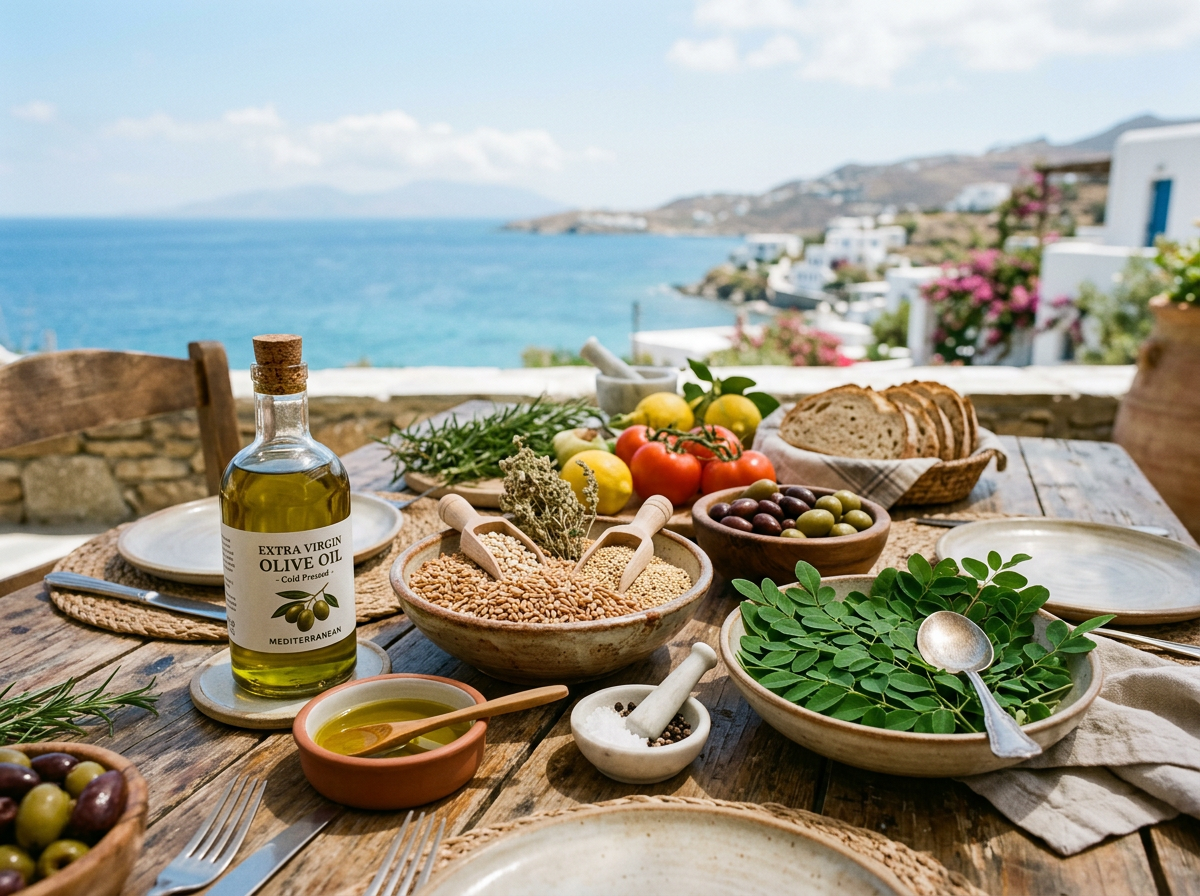
The Mediterranean Diet already holds an extraordinary inheritance: extra-virgin olive oil, whole grains, legumes, vegetables, fruit, fish, aromatic herbs, conviviality and moderation. Moringa can enter into conversation with this model, reinforcing some of its functional aspects — above all when we reason in terms of prevention and the quality of how we age.
Moringa, epigenetics and metabolism
One of the central ideas in the medicine of ageing is epigenetics: the way environment, diet and lifestyle can influence how genes are expressed without altering the DNA sequence itself.
Nutrients and bioactive compounds are not merely fuel. They are also biological signals. They can take part in regulating inflammatory, metabolic and oxidative processes, helping to steer the body toward greater efficiency or, conversely, toward dysfunction.

Moringa contains bioactive molecules such as isothiocyanates, quercetin and chlorogenic acid. These compounds are being studied for their possible role in modulating oxidative stress, the inflammatory response and insulin sensitivity.
The central point, though, needs stating plainly: this is not about presenting Moringa as a therapy or a miracle cure. It is about treating it as a promising functional food, to be placed within an overall dietary model that is balanced and scientifically guided.
The role of the gut microbiota
The gut is now regarded as one of the key organs of metabolic and immune health. The intestinal microbiota takes part in digestion, in modulating inflammation, in producing useful metabolites, and in the constant dialogue between gut, immune system, liver, kidney and brain.
From this angle, Moringa oleifera looks interesting for its possible prebiotic action as well. Polyphenols and fibre can reach the colon and interact with the gut’s microbial ecosystem, encouraging a more balanced environment.
A microbiota in balance contributes to the production of short-chain fatty acids — among them butyrate, essential to the health of the intestinal barrier. When that barrier is compromised, the risk rises that bacterial endotoxins pass into systemic circulation, with the possible activation of chronic low-grade inflammation.
It is precisely this kind of silent inflammation — often called inflammaging — that represents one of the shared biological grounds of pathological ageing and of many chronic-degenerative diseases.

Moringa and kidney health: an important line of research
Another aspect of growing interest concerns kidney health. The kidney is among the organs most vulnerable to biological ageing, to hypertension, diabetes and metabolic overload. A progressive decline in renal function is often a significant marker of frailty.
Some experimental research has examined the potential nephroprotective effect of Moringa oleifera extracts, particularly in models linked to oxidative stress, metabolic damage and diabetic nephropathy. The findings are interesting, but they must be read with rigour: much of the evidence still belongs to preclinical research and calls for further confirmation in humans.
The theme is relevant nonetheless. A form of nutrition able to reduce inflammation, support metabolism and protect organ function may play a meaningful part in preventing pathological ageing.
In older people the question grows more delicate still. We need to sustain muscle mass without overloading the body. We need to protect the skeleton, maintain strength, preserve autonomy and reduce the risk of frailty.
The young, the old, and early prevention
Longevity does not begin at eighty. It begins much earlier.
Younger generations are drifting steadily away from the traditional Mediterranean model, drawn toward ultra-processed foods, excess sugar, hypercaloric snacks, sweetened drinks and disordered eating habits. That shift raises the risk of overweight, insulin resistance, metabolic syndrome and early inflammation.
In this context, to speak of Moringa is also to speak of food education. Introducing a new ingredient is not enough. We have to rebuild a culture of food capable of explaining why some foods protect better than others, why the microbiota matters, why the quality of proteins, minerals and plant compounds can shape future health.
For older people, the argument connects to the prevention of sarcopenia, the protection of the immune system and the preservation of autonomy. A diet rich in nutrients, well balanced and individualised, can help slow the loss of muscle mass, support cognitive function and reduce the risk of frailty.
Not a fashion, but a possible evolution of the Mediterranean paradigm
The Mediterranean Diet has proved its strength over time because it is not merely a list of foods. It is a way of life — a balance of food, movement, social bonds, territory, seasonality, culture and measure.
To integrate Moringa oleifera into this paradigm is not to betray the tradition. It is to ask how the tradition might converse with contemporary research.
Extra-virgin olive oil, legumes, ancient grains, vegetables, wild herbs and functional foods can together build a new vision of prevention — one in which longevity is understood not as the simple lengthening of life, but as the preservation of the capacity to live well: to think, to move, to take part and to remain autonomous.
In this light, Moringa oleifera is not a shortcut. It is a possible tile in a wider mosaic: that of preventive nutrition, of the medicine of ageing, and of a new alliance between science, biodiversity and Mediterranean culture.
This will be the real challenge of the coming years: to turn nutritional knowledge into a tool that is accessible, sustainable and useful for present and future generations. Authentic longevity is not born of a single food, but of a network of daily choices. Moringa can enter that network — if it is used with competence, measure and scientific rigour.
FAQ
What is Moringa oleifera?
Moringa oleifera is a tropical plant whose leaves are studied for their content of plant proteins, minerals, vitamins and bioactive compounds.
Can Moringa replace the Mediterranean Diet?
No. Moringa does not replace the Mediterranean Diet. It can be considered a possible functional food to integrate within a balanced dietary model.
Why does Moringa interest the medicine of ageing?
Because it contains compounds studied for their possible role in oxidative stress, inflammation, metabolism and the gut microbiota.
Is Moringa a cure?
No. It should not be presented as a cure. It is a functional food of scientific interest, but any specific use in the presence of illness must be assessed with a physician.
What is the link between Moringa and longevity?
The link concerns above all preventive nutrition, micronutrients, metabolic balance, the microbiota and the possible support of biological processes involved in healthy ageing.

Manuale Creativo per Fotografi Ribelli
40 idee per riscattare il tuo sguardo fotografico. Un libro di Massimo Usai per chi vuole guardare il mondo con occhi nuovi.
Acquista su Amazon In qualità di Affiliato Amazon ricevo un guadagno dagli acquisti idonei.Scopri di più da
Abbonati per ricevere gli ultimi articoli inviati alla tua e-mail.


1 comment
[…] Roberto Pili è medico specialista in oncologia, studioso delle determinanti della salute e della longevità, della Medicina dell’Aging e della Geragogia, e Presidente della Comunità Mondiale della Longevità. Da oltre trent’anni dedica parte della propria ricerca ai fattori biologici, ambientali, alimentari e comportamentali che favoriscono un invecchiamento in buone condizioni di salute. […]