
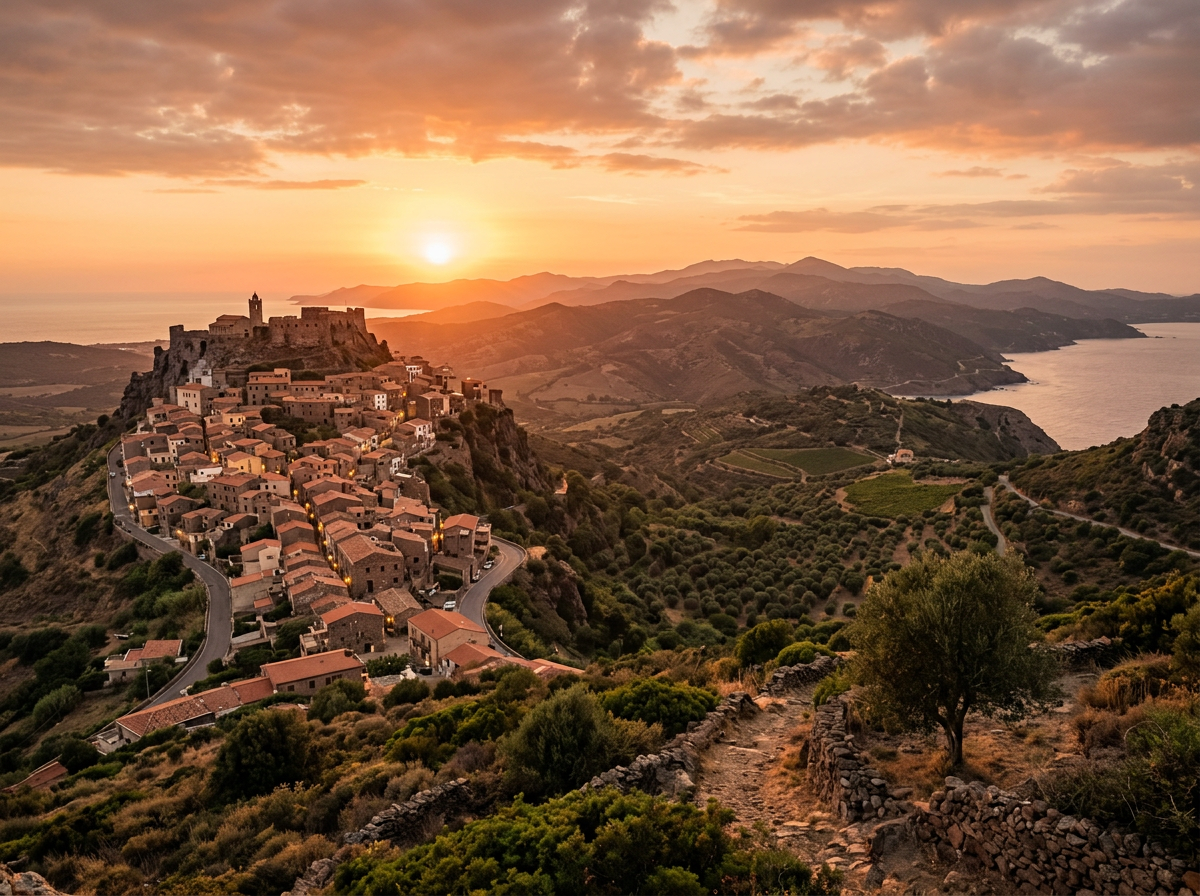
There is a particular quality to the light in Perdasdefogu in the late afternoon. It comes in low and unhurried, the way light moves when it has nowhere urgent to be. The granite turns warm. The air smells of wild herbs and dry earth. Old men sit outside their front doors and watch the day close without any particular sense of loss.
They have seen a great many days close, these men. Some of them over a hundred years’ worth.
Perdasdefogu is a village of just over two thousand people tucked into the Ogliastra mountains of inner Sardinia — far from the coast, far from the resorts, far from most things the rest of the world considers essential. It is also, per capita, one of the places on earth where people live longest. Statisticians have noticed. Scientists have followed. Journalists arrive with notebooks and leave with something harder to transcribe than data.
The question everyone comes here asking is simple: why? The answer, it turns out, refuses to be simple at all.
Blue Zone, but Make It Real
Sardinia was among the first territories identified as a Blue Zone — a term coined by researcher Dan Buettner to describe regions where centenarians cluster in numbers that defy demographic expectation. The island’s interior, particularly the Nuoro and Ogliastra provinces, showed a concentration of people over a hundred years old that no one could explain away with genetics alone.
What researchers found, again and again, was that the longest-living Sardinians shared not just a bloodline but a way of being in the world. A set of daily habits so quietly radical that they barely register as habits at all — they are simply life, as it has always been lived here.
Dr. Roberto Pili, president of the World Longevity Community (Comunità Mondiale della Longevità), has spent years studying this phenomenon. His position is clear: the variables that matter most are not pharmaceutical. They are behavioural, relational, and deeply cultural. The body, he argues, responds to the life built around it.
The Perdas Code
From the village of Perdasdefogu came something researchers began calling the Codice Perdas — the Perdas Code. Not a wellness programme. Not a supplement protocol. A careful documentation of the daily patterns shared by the village’s extraordinary population of centenarians: how they ate, how they moved, how they related to each other and to time itself.
What the Perdas Code reveals is less a secret than a reminder. That the body does well when it is not in conflict with its own rhythms. That stress, isolation, and disconnection from the physical world carry a biological cost. And that villages like Perdasdefogu, by accident of geography and culture, have spent centuries doing something the modern world has been systematically undoing.
A Table Set for Slowness
The Sardinian diet is not a trend. It predates every trend by centuries.
On the tables of Perdasdefogu’s oldest inhabitants you will find pane carasau — the paper-thin flatbread that shepherds carried across the hills because it kept for weeks — alongside slow-cooked legumes, seasonal vegetables dressed with local olive oil, sheep’s milk cheese aged in the mountain air, and very little else that would require a label to explain.
Pecorino sardo deserves a particular mention: dense, mineral, rich in conjugated fatty acids and protein, it is the kind of food that nutritional science keeps rediscovering after decades of misguided fat-phobia. The centenarians of Perdasdefogu have been eating it their whole lives, without apology and without moderation.
Meat is present, but restrained. Fish appears, but does not dominate. What dominates is the plant — and the patience with which everything is prepared. The meal is not a refuelling stop. It is an event, shared, extended, and considered the emotional centre of the day.
Movement as Fluency, Not Discipline
No one in Perdasdefogu has a gym membership. The idea would be baffling.
The centenarians here have spent their lives walking — to the fields, to neighbours, along paths their grandparents walked before them. They have worked with their hands: tending animals, harvesting, repairing, building. Their bodies have been in continuous, low-intensity dialogue with the physical world, not as exercise in the modern sense, but as the simple texture of a working life.
This distinction matters more than it might seem. The body was not designed for sedentary existence interrupted by forty-five minutes of cardio. It was designed for the kind of constant, gentle movement that Sardinian village life still, remarkably, provides. The cardiovascular benefits are real. So are the cognitive ones. So is the simple fact that when your body is used, it tends to keep working.
The Community That Heals
Here is the variable that no fitness tracker can measure: belonging.
In Perdasdefogu, as in much of Sardinia’s interior, the social fabric is still largely intact. Elderly people are not warehoused. They are present — at the table, at the piazza, at the centre of family life, recognised as custodians of memory and experience. Younger generations still seek them out. This is not nostalgia. It is architecture: a social structure that gives older people a function, and therefore a reason.
The research on this is consistent and rather devastating for the modern world: chronic loneliness carries a health risk comparable to smoking fifteen cigarettes a day. The inverse is also true. Strong social bonds reduce cortisol, lower inflammation, and appear to extend life in ways that remain only partially understood but are impossible to dismiss.
The World Longevity Community, founded by Dr. Pili, exists in part to reconstruct this architecture for people who no longer live in mountain villages — who live in cities, alone or in fragmented families, disconnected from the rhythms that Perdasdefogu has never entirely lost. It is, at its core, an attempt to make belonging available again, as a practice rather than a given.
Something That Doesn’t Translate as Spirituality
The word is imprecise, but it will have to do.
The oldest Sardinians carry with them a quality of orientation — toward nature, toward community, toward something larger than the individual life — that functions as a kind of psychic ballast. It reduces existential anxiety. It provides continuity between past and future. It makes ageing something other than a crisis.
You can call it faith, if faith is your framework. You can call it rootedness, or belonging, or simply the accumulated weight of a life lived in one place over a long time. Whatever it is, it appears to be protective. The body, it seems, does better when the mind knows where it stands.
What Travels, and What Doesn’t
Perdasdefogu cannot be replicated. The light there at five in the afternoon, the particular silence of those streets, the faces of people who have lived entirely within one landscape — none of that is portable.
But some of what happens there is.
Eating real food, cooked slowly, eaten with others. Moving through the day without treating movement as a chore. Building relationships that have depth and duration. Slowing down not as a luxury but as a form of intelligence. Finding a structure of meaning that outlasts any single ambition.
These are not Sardinian secrets. They are human ones, temporarily mislaid in the noise of contemporary life. Perdasdefogu simply never mislaid them.
And on some quiet afternoons, when the granite turns warm and the old men watch another day close from their doorways, that fact alone seems like the most extraordinary thing in the world.
Feature by Urban Mood Magazine editorial team. Scientific contribution by Dr. Roberto Pili, President of the World Longevity Community.


Manuale Creativo per Fotografi Ribelli
40 idee per riscattare il tuo sguardo fotografico. Un libro di Massimo Usai per chi vuole guardare il mondo con occhi nuovi.
Acquista su Amazon In qualità di Affiliato Amazon ricevo un guadagno dagli acquisti idonei.Scopri di più da Urban Mood Magazine
Abbonati per ricevere gli ultimi articoli inviati alla tua e-mail.


