
The link between music and longevity almost never appears on a longevity checklist — yet in every Blue Zone on earth, the people who live longest do the same thing: they make music together, and almost never alone.
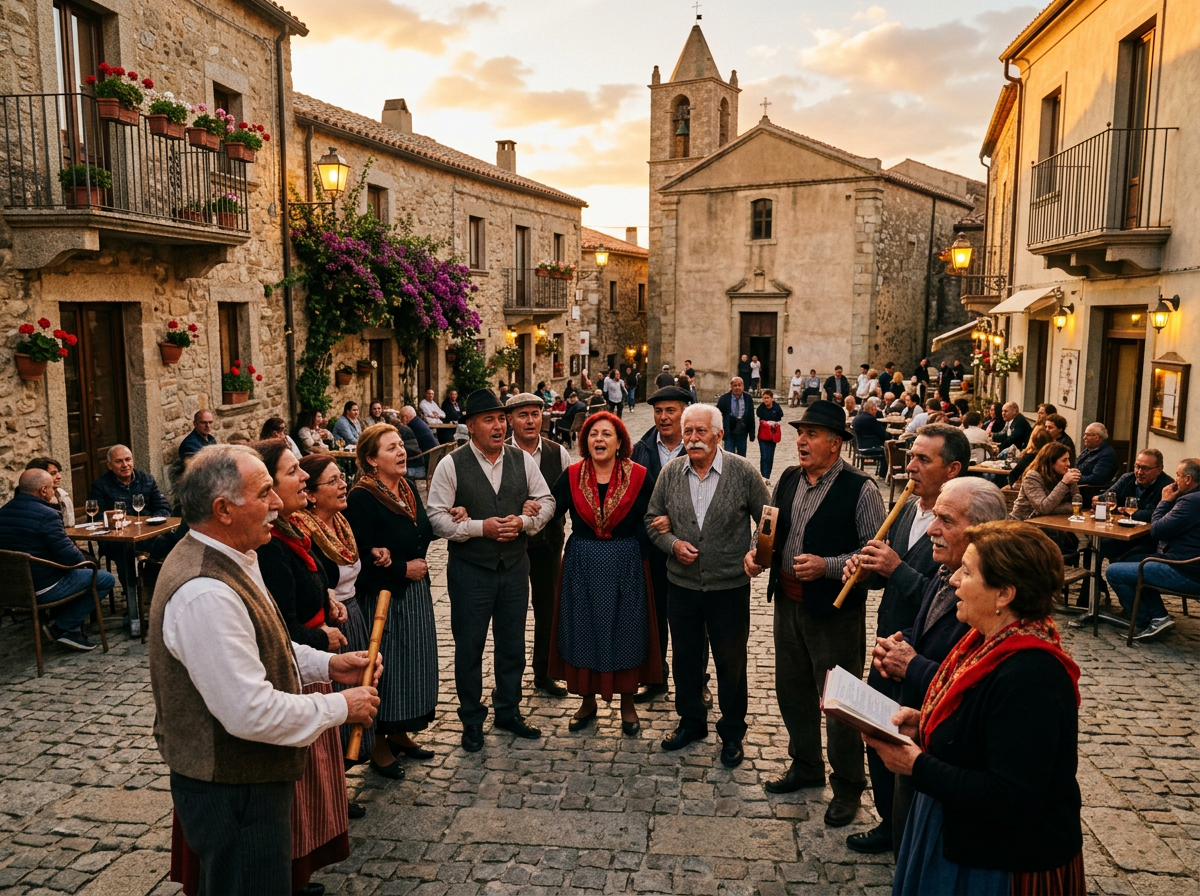
A village square in Sardinia: the cantu a tenore
There is a village in the Barbagia, the rocky heart of Sardinia, where the evening only really begins once four men have found each other in the square. They stand close, almost touching. One starts a single thread of melody, the boche, and the others fold in beneath him — the mesu boche, the contra, and finally the bassu, a sound that seems to rise out of the ground.
This is cantu a tenore, the polyphonic singing recognised by UNESCO in 2005. The men will tell you the voices imitate the things shepherds live among: the wind, a flock, running water, the low complaint of an ox. I have come to think this is not a quaint footnote to the Blue Zones. It is part of the explanation.
Why the Blue Zones never sing alone
When Dan Buettner mapped the five places where people most reliably pass a hundred — Sardinia, Okinawa, Nicoya, Ikaria and Loma Linda — he catalogued the obvious things: the plants on the plate, the daily walking, the wine taken slowly with friends. But spend real time in any of them and you notice something the spreadsheets struggle to hold. These are loud communities.
Travel east to Okinawa and the instrument changes but the instinct does not. No gathering ends without the sanshin, the three-stringed cousin of the banjo, and the min’yo folk songs everyone somehow knows. At some point someone stands, raises both hands and begins the kachashi: an improvised, joyful dance that pulls grandmothers and grandchildren into the same small circle.
On the Nicoya Peninsula it is the marimba, played at the festivals that punctuate the sabanero cowboy year. In Ikaria it is the panigiria — saint’s-day feasts that begin at sundown and end near dawn, the whole village turning in the slow spiral of the Ikariotikos, the young steadying the old.
What science says about music and longevity
Here the research quietly catches up to the shepherds. Studies of group singing find that when people sing together their breathing synchronises, and with it the rhythm of their hearts. The act floods the body with the chemistry of a long embrace — endorphins that dull pain, oxytocin that builds trust.
People who sing in groups report less loneliness and lower stress, and loneliness is now understood to be as corrosive to a long life as the habits we are always told to quit. Buettner’s four pillars — eat wisely, move naturally, connect, hold a sense of purpose — are not four separate disciplines here. Music collapses them into a single act.
They kept the circle, and the circle kept them.
How to bring more music into a longer life
The lesson is not that we should learn the launeddas, the ancient triple-reed pipes of Sardinia, or memorise a Greek line dance. It is smaller and harder: to make music something we do with people rather than at them.
- A kitchen where someone still plays an instrument.
- A table where someone sings, badly, and is not embarrassed.
- A regular gathering — choir, session, festival — that asks you to stand up together.
If this echoes the way the Blue Zones also gather around food, ritual and unhurried time, that is the point — and it is the thread we follow in what the world’s longest-lived communities share, and the pace explored in cinema and longevity.

Key takeaways
- In all the Blue Zones, music is communal, not solitary.
- Group singing synchronises breath and heart rate and reduces loneliness.
- It quietly delivers movement, connection and purpose in one daily act.
- You don’t need talent — you need other people and a reason to begin.
Frequently asked questions
Does singing really help you live longer?
Singing in a group is linked to lower stress, reduced loneliness and stronger social bonds — all factors associated with healthier ageing. It is not a cure, but it touches several of the habits the Blue Zones share.
Which Blue Zone is most associated with music?
Sardinia’s cantu a tenore is the most famous, but Okinawa, Nicoya and Ikaria all build music into everyday celebration.
Do you have to be a good singer to benefit?
No. The benefits come from singing together, not from singing well — participation is the active ingredient.

Manuale Creativo per Fotografi Ribelli
40 idee per riscattare il tuo sguardo fotografico. Un libro di Massimo Usai per chi vuole guardare il mondo con occhi nuovi.
Acquista su Amazon In qualità di Affiliato Amazon ricevo un guadagno dagli acquisti idonei.Scopri di più da
Abbonati per ricevere gli ultimi articoli inviati alla tua e-mail.


