
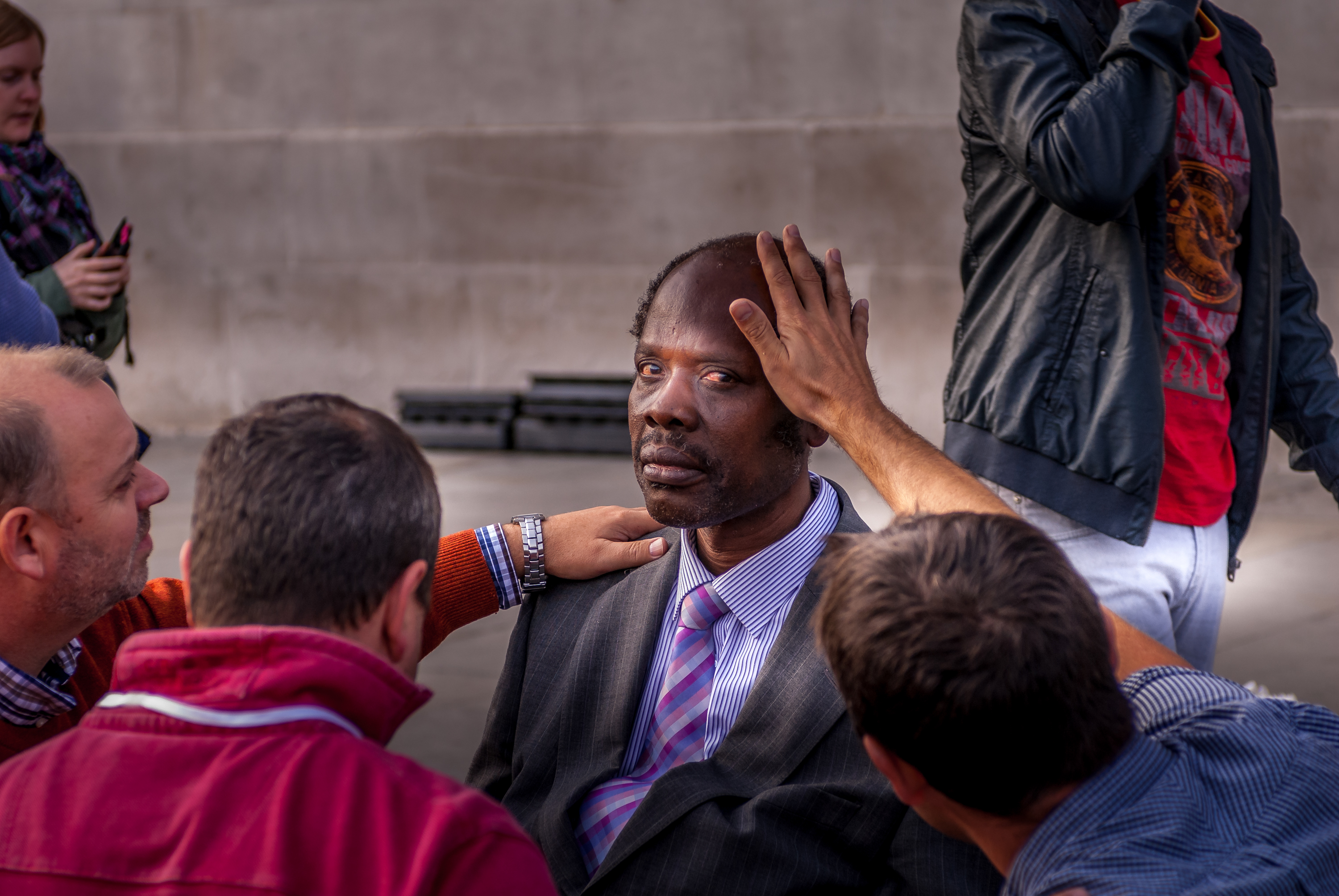
His legs stopped at the river. Not dramatically — they simply finished, the way a watch finishes, and he sat down on the long grey step of concrete because it was there and because he was not going to make it any further than there. Around him London kept its appointments. A bus exhaled at the lights. Somewhere a child was crying about an ice cream, two registers of grief below his own.
He had been walking since the phone call. He could not now have said for how long. The water went past the colour of a coin left out in the rain.
His mother used to say it down a bad line, the words arriving a half-second late, as though they had swum the whole way. If you can’t come to me, I’ll go to you. She said it the first winter, when the ticket cost more than a month of the work he had found, and she said it the winter after that, and every winter, the way other people say Happy Christmas — a thing you repeat precisely because everyone knows it will never be tested. She never had the papers. He never had the money in the same year she had the strength. The distance between them was built of small, reasonable amounts: a visa fee, a fare, a season. She had always meant to come. He had always, next year, meant to go.
Now there was no me left to come to, and no you to do the going, and he sat on the South Bank with both halves of the sentence loose in his hands like a cup that had come apart at the handle.
He did not notice the first man arrive. He noticed the hand — a stranger’s hand, warm and uninvited, settling near the collar of the good suit he had put on that morning for a reason he could no longer remember. Then a man crouched in front of him, and another, and another, until the air before his face was full of strangers, close enough that he could smell the rain in their jackets. One of them, younger, a watch loose on his wrist, lifted a palm and laid it flat against his forehead — the way you gentle a horse, or test a fever, or simply hold a head that has decided it can no longer hold itself.
He should have been afraid. In every country he had lived in, a circle of men closing around you on the ground had meant one thing, and it was never this. But there was no taking in it. There was only the weight of the hands, and the low sound the men were making, which might have been a prayer and might have been the noise people make when there are no words left and they have agreed, without saying so, not to leave you alone inside the silence.
He did not know them. He would never know them. That, he understood afterwards, was the whole of it.
Behind him a woman stood reading her phone, her thumb moving, her face lit blue and elsewhere. She did not look up. A few steps further off, a man in a leather jacket was already turning away, an arm raised over his head, half into the rest of his evening. The city was not cruel. The city was only doing what a city does: holding, in one square metre of wet concrete, a man coming apart in the arms of strangers and, a body’s width away, two people for whom it was an ordinary Tuesday and for whom he was not even in the frame.
He understood then, with the cold clarity that arrives only at the bottom of things, that this was how the promise had always been going to be kept. Not by the one who made it. The people who love you across an ocean send the words and mean them and run out of seasons. It is the others — the ones with no reason, no history, no debt — who cross the last few feet of the world and put their hands on you.
When he could stand, they helped him stand. Nobody asked his name and he offered none; it would have been a kind of trespass, on both sides, to turn this into an acquaintance. The young man with the loose watch held his arm a moment longer than the rest, and then let go, and the circle opened the way water opens and closed behind him and was gone into the crowd as though it had never formed.
He walked to the bridge. The river went on being the colour of a rained-on coin. Somewhere to the south, under a kinder light, the sentence his mother had said into a bad telephone for twenty years had finally come true, and she had not lived to see who kept it for her. The going, it turned out, gets done by whoever is standing near enough. He did not look back at the strangers. You don’t, for the ones who reach you by accident.

If you can’t come to me, I’ll go to you.

Manuale Creativo per Fotografi Ribelli
40 idee per riscattare il tuo sguardo fotografico. Un libro di Massimo Usai per chi vuole guardare il mondo con occhi nuovi.
Acquista su Amazon In qualità di Affiliato Amazon ricevo un guadagno dagli acquisti idonei.Scopri di più da
Abbonati per ricevere gli ultimi articoli inviati alla tua e-mail.


