
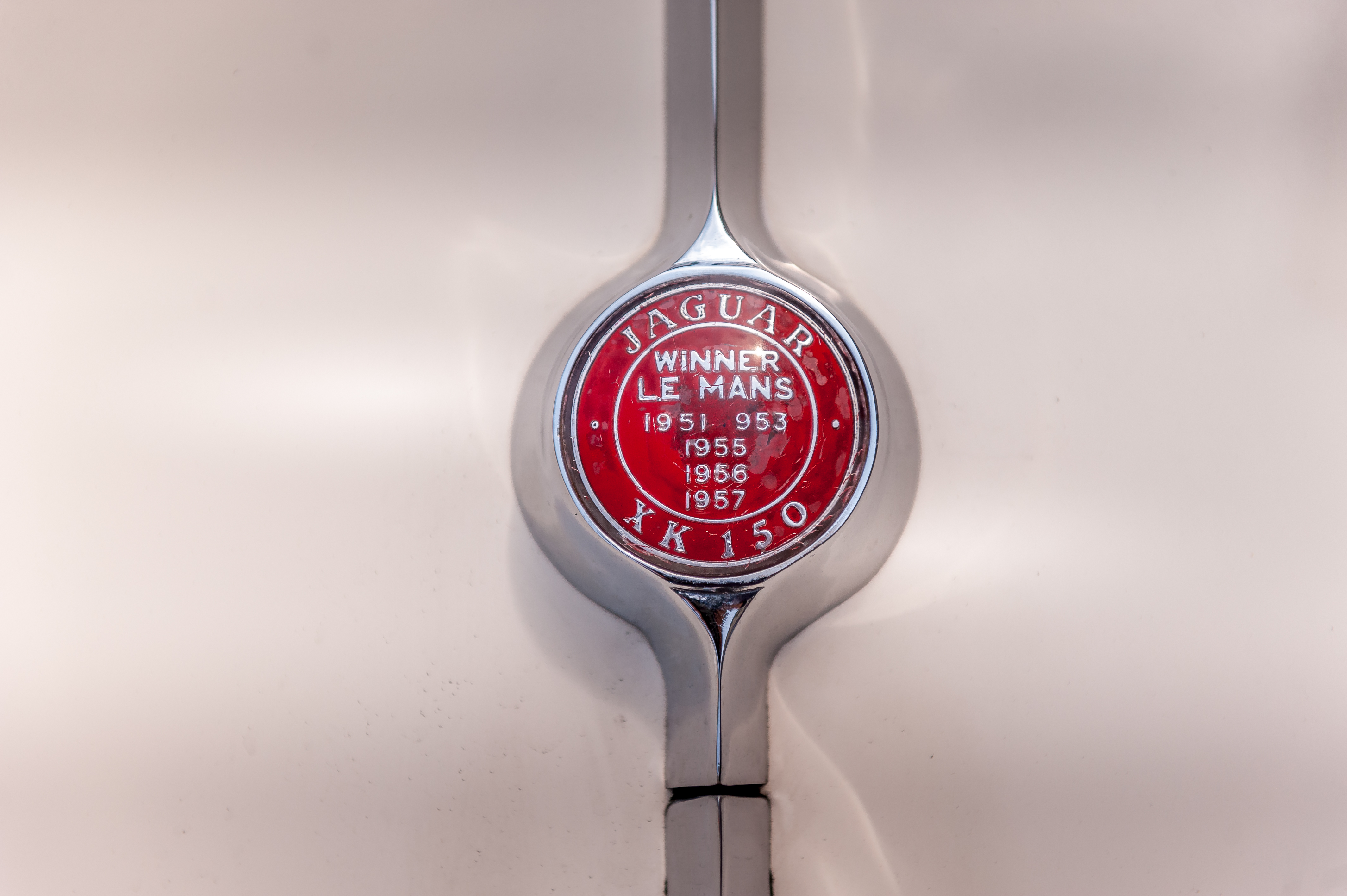
On the flank of a Jaguar XK150, sunk into a teardrop of polished chrome, there is a small red badge. It reads: Winner — Le Mans — 1951, 1953, 1955, 1956, 1957. Five years. Five victories. The enamel has clouded a little where the light catches it, the way old varnish goes milky, but the claim is unmistakable, and it is the kind of claim a car wears the way a soldier wears ribbon.
Here is the thing the badge does not tell you. The XK150 won none of those races.
It could not have. The XK150 arrived in 1957, the last and most civilised of Jaguar’s XK road cars — wider, softer, fitted with disc brakes and wind-up windows, built for the long continental road rather than the pit lane. By the time it reached the showroom, four of those five Le Mans wins were already history, and the fifth was being earned the same season by a different machine entirely. The Jaguar XK150 Le Mans badge is not a record of what this car did. It is an inheritance.
Jaguar XK150 , The cars that actually won
The medals belong to two predecessors, and they are worth knowing, because the badge is really a compressed biography of a decade.
1951 and 1953 — the C-Type. The C-Type took Le Mans on its debut in 1951, in the hands of Peter Walker and Peter Whitehead, lean and aerodynamic where its rivals were still broad-shouldered. Two years later it returned with Dunlop disc brakes — a genuine advantage on a circuit where everyone else was still cooking their drums into the night — and Tony Rolt and Duncan Hamilton became the first crew to average over 100 mph across twenty-four hours. The story goes that Hamilton drove part of it hungover, having been told the night before they were disqualified. They weren’t.
1955, 1956, 1957 — the D-Type. Then came the car that gave Jaguar its myth: the D-Type, with its single dorsal fin and its monocoque centre, a shape that still looks like it was drawn by the wind itself. Mike Hawthorn and Ivor Bueb won in 1955 — the year of the catastrophe in which more than eighty spectators died, the darkest hour the sport has known, and a victory the badge records without a word of the shadow over it. In 1956 the works cars faltered and a privateer Scottish team, Ecurie Ecosse, carried a D-Type to the top step instead. In 1957 the same blue-and-white outfit did it again, and Jaguars finished first, second, third, fourth and sixth — a near-total occupation of the result sheet.
Five wins, then, but spread across two cars and several teams, none of which was the XK150. The badge collapses all of that into a single red disc and bolts it to a grand tourer. It is, if you want to be unromantic about it, marketing.
Why the badge is more honest than it looks
And yet I keep coming back to it, because there is something true in the gesture.
A racing programme is not separate from the cars people buy. The disc brakes that won in 1953 are the disc brakes that stop the XK150 on a wet road in 1958. The aerodynamic discipline learned at three in the morning on the Mulsanne Straight is the same discipline that shapes the bonnet under which a family’s luggage rides to the South of France. The badge is borrowed glory, yes — but it is borrowed from a lineage the road car genuinely descends from. The XK150 is not lying. It is claiming a family name.
This is what a badge is for, in the end. It is a small monument you can carry at speed. Most monuments ask you to stand still in front of them; this one is designed to be seen as it passes, a flash of red against cream, legible for the half-second it takes to overtake. It is memory engineered for motion.
Look at how it is made. The chrome does not simply hold the enamel — it swells around it, a raindrop frozen mid-fall, so that the badge sits at the centre of its own little pool of light. The red is not the red of the bodywork; it is louder, sacramental, the only saturated colour on an otherwise pale and unhurried car. Everything about the design says: stop here, this is the important part. On a vehicle built for understatement, the one immodest thing is the record of what the marque achieved before you bought it.
What we hang on ourselves
There is a small human comedy in this, and it is why the photograph holds the eye longer than a chrome trinket has any right to.
We all wear badges for wins that were not entirely ours. The graduate wears the university’s name; the city wears the reputation of the generation before; the heir wears the surname and is congratulated for it at parties. The XK150 simply does it more beautifully and with less embarrassment than the rest of us — it states the inheritance in enamel and lets you make of it what you will.
What you make of it, mostly, is desire. Because the badge works. You read Winner — Le Mans — five times and some part of you transfers the courage of those nights to the calm machine in front of you, and that transfer is the whole point. The road car was never going to win Le Mans. It was going to let you feel, on an ordinary Tuesday, three minutes from home, that you were driving something descended from cars that did.
The clouding in the enamel only deepens it. The badge is ageing now, decades past the last of its dates, and the wins it commemorates are further from us than the XK150 was from them when it left the factory. It has become a monument to a monument — a small red record of a glory that was already, when it was fitted, slightly in the past.
That is the quiet brilliance of it. The car never had to win anything. It only had to remember, on our behalf, that someone once did.


Manuale Creativo per Fotografi Ribelli
40 idee per riscattare il tuo sguardo fotografico. Un libro di Massimo Usai per chi vuole guardare il mondo con occhi nuovi.
Acquista su Amazon In qualità di Affiliato Amazon ricevo un guadagno dagli acquisti idonei.Scopri di più da
Abbonati per ricevere gli ultimi articoli inviati alla tua e-mail.


