We like to imagine that ideas arrive fully formed.
A scientist has a revelation in the middle of the night. A musician hears a melody that seems to emerge from nowhere. A writer discovers the perfect opening sentence while staring out of a train window.
The myth of inspiration is attractive because it suggests that creativity is magical. That some people are simply blessed with access to a mysterious source of originality unavailable to the rest of us.
Reality is usually more interesting.
Most ideas are not born in isolation. They emerge when different worlds collide.
The history of human progress is filled with examples.
The Renaissance flourished because artists, scientists, engineers, philosophers and merchants shared ideas across disciplines. The Industrial Revolution accelerated when practical craftsmanship met scientific understanding. The digital age emerged from a collision between mathematics, engineering, psychology and design.
Innovation rarely comes from staying within the boundaries of a single field.
Instead, it happens at the intersections.
The writer who studies architecture begins to see structure differently. The photographer who listens carefully to music develops a stronger sense of rhythm and timing. The entrepreneur who travels discovers solutions hidden in cultures far from their own.
Creative breakthroughs often begin as unexpected conversations between unrelated ideas.
This principle is visible in everyday life as much as in history.
Think about the people who have influenced you the most. They are often individuals who introduced you to a different way of seeing the world. A teacher. A colleague. A friend. A stranger encountered during a journey.
Each interaction leaves behind fragments of perspective.
Over time, those fragments connect.
The result is a new thought that did not exist before.
Perhaps this is why curiosity remains one of the most underrated human qualities. In an era where algorithms constantly try to show us more of what we already know, genuine creativity requires the opposite approach. It demands exploration. It asks us to leave familiar territory and wander into unfamiliar territory.
The most creative minds are rarely the most specialised.
They are often the most connected.
They read broadly. They travel. They listen. They remain interested in subjects that appear to have nothing to do with their profession.
And yet those seemingly unrelated experiences eventually become the raw material from which new ideas emerge.
The British writer Arthur Koestler described creativity as the process of bringing together previously unrelated frames of reference. Decades later, Steve Jobs would express a similar thought when he spoke about creativity as simply connecting things.
The language changed, but the principle remained the same, highlighting the enduring nature of core beliefs that transcend the barriers of words and expressions. This continuity suggests that while our modes of communication may evolve and transform, the fundamental ideas and values we hold dear continue to unify us, serving as a bridge that connects diverse cultures and perspectives. Even in the face of linguistic diversity and cultural shifts, these shared principles allow us to navigate our differences and foster understanding in an increasingly interconnected world.
Progress happens when connections happen.
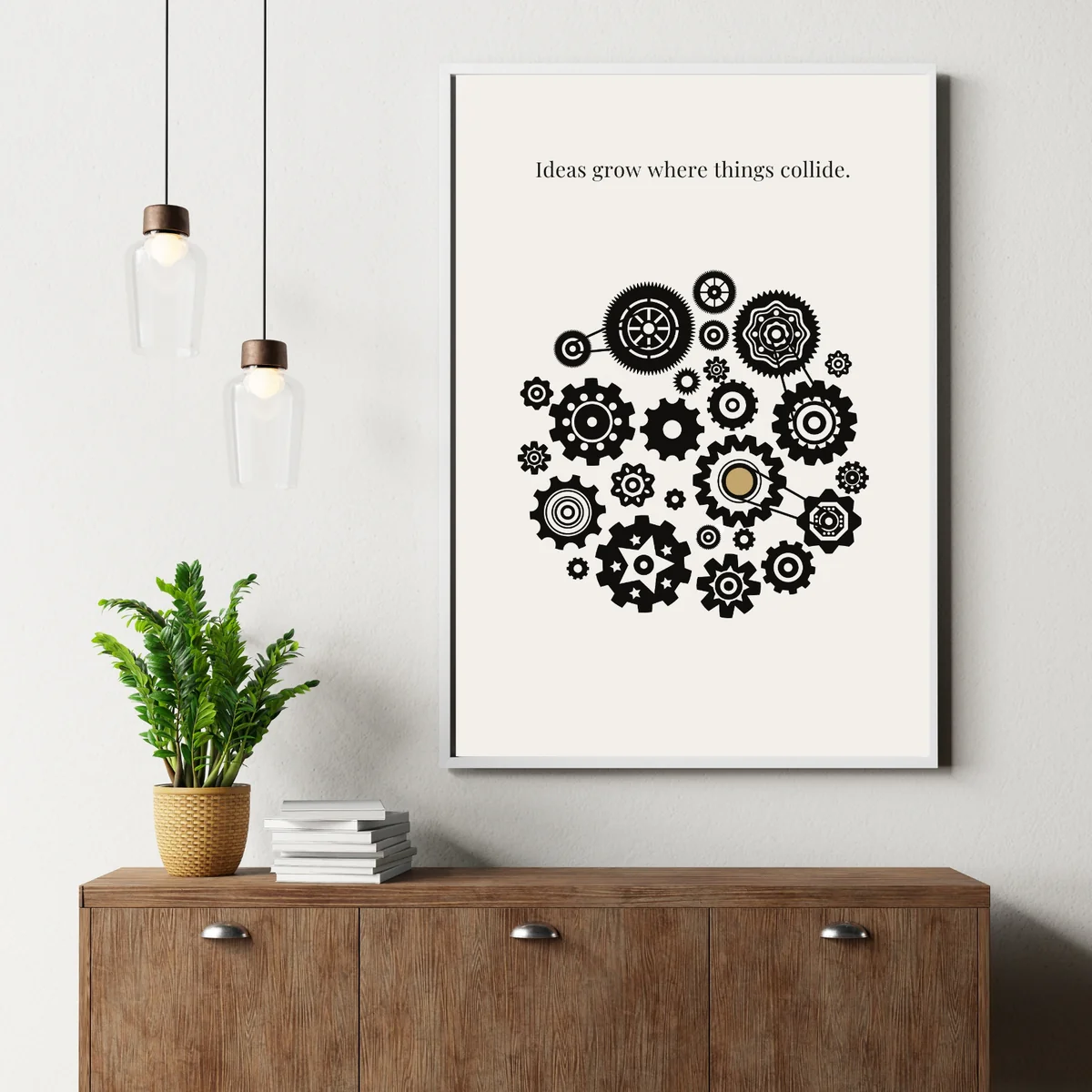
Perhaps that is why symbols such as interlocking gears remain so powerful. A single gear can turn endlessly without changing much. Connect it to another gear and suddenly motion is transferred, amplified and transformed.
Ideas behave in much the same way.
One idea alone can be interesting.
Two ideas together can change the world.
In a time when many of us spend our days scrolling through endless streams of information, it may be worth remembering that creativity is not measured by how much we consume but by how effectively we connect what we discover.
The next breakthrough, whether personal or professional, may not come from searching harder.
It may come from allowing different thoughts, experiences and perspectives to meet.
Because ideas rarely grow in perfect order.
They grow where things collide.


Manuale Creativo per Fotografi Ribelli
40 idee per riscattare il tuo sguardo fotografico. Un libro di Massimo Usai per chi vuole guardare il mondo con occhi nuovi.
Acquista su Amazon In qualità di Affiliato Amazon ricevo un guadagno dagli acquisti idonei.Scopri di più da Urban Mood Magazine
Abbonati per ricevere gli ultimi articoli inviati alla tua e-mail.


